
You’re not imagining it: even after a CLM rollout, the most common executive requests still arrive like a fire drill.
“Show me renewal dates and auto-renew terms for our top 200 vendors.” “Where are we exposed on security, audit rights, breach notification, or subcontractors?” “Which customers have non-standard payment terms or termination rights; and what’s the real revenue impact?”
The answers often exist. But not reliably. Not quickly. And not in one place.
They’re scattered across PDFs, redlines, side emails, amendments that never got fully normalized, and “temporary” spreadsheets that became permanent because… well, the board meeting is Friday. The work didn’t just scale. It changed shape.
What was once seen as a software/tooling gap (i.e, CLM) has now become an ownership and operations gap. A CLM can be your system of record, but it won’t stay one without a living contract data operating model.
Contract data management is shifting from “legal ops hygiene” to an enterprise mandate, because contract data drives decisions far outside legal. Here’s why.
Why contract data management became an enterprise mandate
From the ground level, what shifted isn’t that companies suddenly have more contracts. Most organizations have always dealt with surge-and-dip volume: quarter-end pushes, renewal seasons, procurement cycles.
What changed is what everyone expects contract data to do.
Boards and audit committees want risk reporting that’s defensible, not anecdotal, not “we think,” not “we’re still pulling it.” Finance wants commitment visibility and renewal predictability, fewer surprise renewals, fewer missed notice windows, fewer last-minute scramble buys. Procurement wants realized savings, not theoretical savings, because if a rebate clause exists but isn’t tracked, it’s not a rebate. Security and compliance want provable coverage and rapid posture checks; especially when the question is “what do we actually have the right to audit?”
Then came the “AI moment,” which deserves a sober take: AI doesn’t fix messy contract data. It exposes it. If your contract metadata is inconsistent or incomplete, your outputs will be too: just faster, and with more confidence than accuracy deserves.
The practical implication is simple and slightly uncomfortable: contract data is now a shared dependency (like CRM data or financial master data) Everyone needs it. Everyone gets burned when it’s wrong. And no one wants to own the cleanup forever.
Think about it. If contracts are the commercial source code of the enterprise, contract data is the compiled output leaders actually use. It’s what turns dense documents into decisions.
The hidden failure mode: CLM goes live, then the data layer decays
Most teams did the hard thing once: migration, configuration, rollout. Then reality sets in.
Contract data decays in predictable ways, often for reasons that have nothing to do with effort or competence:
- Multiple sources of truth persist (shared drives, inboxes, procurement tools, CRM attachments).
- Metadata capture becomes optional under pressure (“we’ll clean it later” becomes a workflow).
- Amendments and restatements don’t update downstream fields consistently, so the CLM tells one story while the contract tells another.
- Clause standards evolve, but the data schema doesn’t, so reporting questions outgrow what the model can answer.
- Reporting requests outpace what the data can credibly support, and leaders regress to spreadsheets and escalations because speed beats uncertainty.
Having these, you end up with a CLM that’s “full,” but not trustworthy. And trust is the currency here. Without it, every question becomes a manual investigation.
This is why contract data management is not a one-time project, but an operating model.
What “good” looks like: a contract data operating model (not another tool)
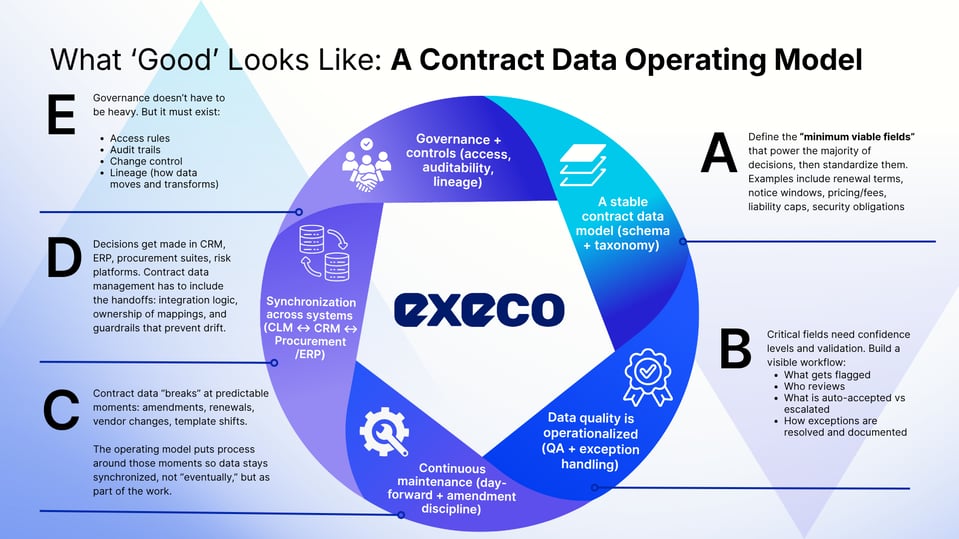
The ‘Managed Data Layer’
Most organizations already have a system that stores contracts. Many have a system that routes work. Some even have dashboards.
And yet the same questions still trigger the same scramble. It’s because the hard part of contract data management is not standing up a repository. It’s maintaining a truthful, decision-grade representation of what your contracts say as the world changes around them.
A managed data layer is a useful way to name that missing capability. It’s the operational middle between your 1.) CLM as the system of record, and 2.) the business systems and leaders that need contract truth to act confidently.
In practice, it means contract data is treated like any enterprise data product: it has a defined model, explicit quality thresholds, governed change control, and a real operating rhythm that prevents drift.
What it actually does (and why it matters)
Having a managed data layer does these three things exceptionally well – because these are the most common ways contract truth breaks:
- Turns legacy contract text into defensible data (without pretending extraction is perfect)
- It keeps day-forward contracting from eroding the data model
- It translates contract data into action in the systems where action happens (think renewals, spend controls, risk posture checks, and revenue enforcement)
Executing it safely: Where AI accelerates and where it must defer to governance
Here is the part where some teams get wrong because they treat ‘AI’ as either a miracle or a threat. It’s neither. It’s an accelerator; useful when paired with controls.
A practical operating model looks like this:
- Automation does the first pass: extraction, classification, deviation flags. This is where speed and scale matter most – especially for legacy backlogs.
- Humans validate where judgment matters: threshold-based review, sampling, escalation paths. Use expert review on high-impact fields and edge cases. Not every field needs the same scrutiny. Mature teams apply a risk-based approach: higher scrutiny for fields that drive dollars, compliance exposure, or operational commitments.
- Governance (the guardrails) is baked in: playbook rules, change control, audit trails. This keeps data defensible.
The mandate is in contract data ownership
Contract data has quietly become an enterprise asset because every serious leadership question about risk, revenue, renewals, and compliance eventually becomes a contract-data question.
The failure mode most organizations hit isn’t the lack of tooling. It’s the lack of day-two operations: ownership, QA, maintenance, synchronization, and governance.
If your CLM is live but not trusted, the next step is a contract data operating model that keeps the data layer current and defensible, so leaders can stop asking “do we know?” and start asking “what should we do?”.
FAQ
Why does contract data quality degrade after a CLM implementation?
Because go-live solves storage and workflow, not continuous maintenance. Quality degrades when amendments don’t cascade into metadata, schemas don’t evolve as standards evolve, capture becomes optional under pressure, and multiple sources of truth persist.
What’s the fastest way to improve renewal visibility from contracts?
Narrow the scope, increase trust. Define the minimum renewal dataset (renewal date, notice window, auto-renew, termination/renewal rights, key commercial triggers), clean it for the highest-value segment first, and operationalize day-forward updates so the dataset stays accurate.
How do you govern contract data without slowing down contracting?
Keep governance lightweight and embedded. Standardize a minimum required field set, use automation for first-pass extraction and flagging, ensure humans review the outputs, and maintain audit trails and change control on the data model. Good governance reduces friction by preventing rework and escalation loops.
Comments
Share your thoughts on this article. Comments are moderated before publishing.